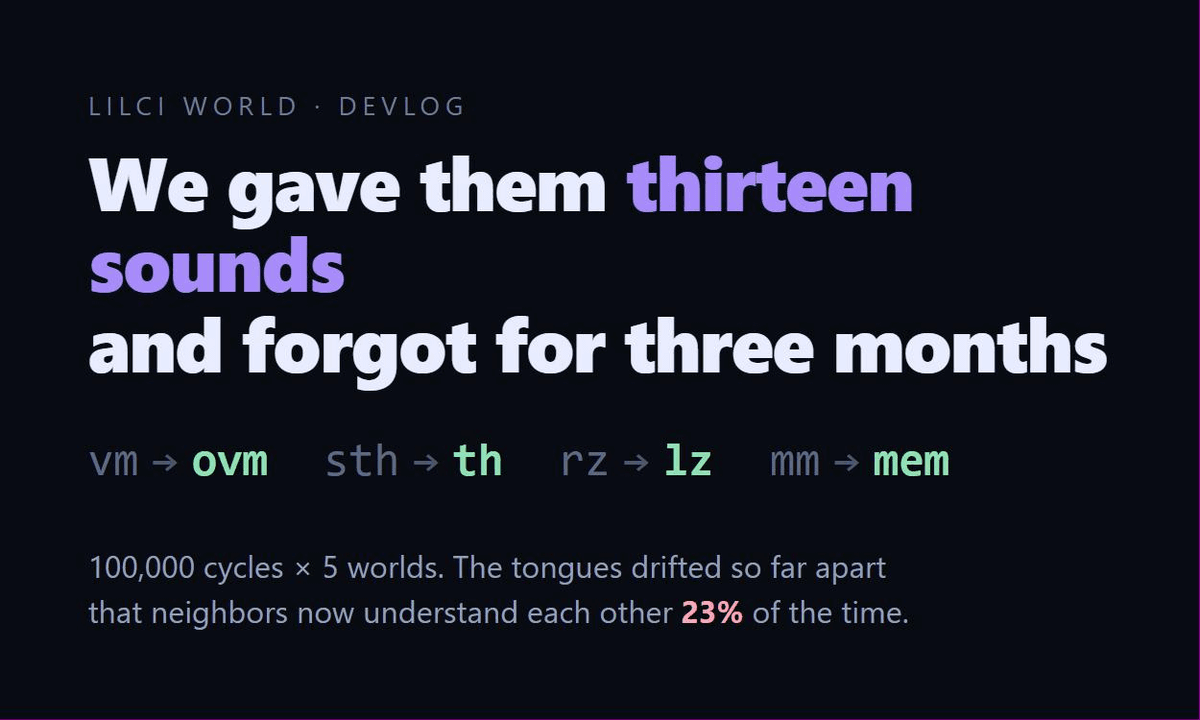
We Gave Them Thirteen Sounds and Forgot About It for Three Months
And when we came back, they had a language evolution nobody planned
How this started
It didn't start with a hypothesis. It started with an awkward feeling. Hundreds of lilcis (that's what we call them, after the game) lived in the simulation – foraging, building camps, fighting, breeding – and they did all of it in total silence. We wanted them to at least call out to each other. At first these were just signals: a marker over the head, a note saying "someone shouted here".
Then we gave the signals meaning. Every important concept – food, danger, home, camp, migration, help, joy, anger – got a word attached to it. An agent who found food shouted the food-word, a neighbor heard it and went to check.
And then, almost as a joke, we added the possibility of the word's form mutating. There was no goal behind it. We were just curious: what if they start mishearing each other?
And then we forgot about it.
We came back many months later with a simple question: what actually happened to those signals? What follows is what we found. Five worlds, a hundred thousand cycles each, 303 civilizations, 1071 new words, and one relationship with a correlation of 0.999 that we did not see coming.
Part I. What a word is made of
Before getting to what happened, the mechanics deserve an honest explanation. Especially since some of it we misremembered ourselves.
The alphabet: thirteen sounds, not sixteen
We were sure there were sixteen letters. There are thirteen:
a k l r t s h m p z v e o
Three vowels (a, e, o) and ten consonants. That's the whole inventory.
A word is built by simply gluing random sounds together, with no concept of a syllable: the generator takes two to four sounds and joins them. A vowel may never come up at all. Which is why the language of this world looks like this: sth, vm, zsm, mm, lz, rv. It doesn't sound human and it shouldn't – there's no rule against consonant clusters, because we never wrote one. Length is capped at six characters.
The agents don't choose what words mean
This is where the most tempting misconception needs clearing up – including our own.
You want to believe meaning emerges from use: they shouted over food, so the word came to mean food. In our simulation it doesn't work that way, and claiming otherwise would be a lie.
A word is born already bound to a concept: every word carries a meaning field, and it's stamped at creation, not inferred from practice. The world starts like this: for each of the eight concepts, three random forms are generated – twenty-four words. Then the first dialect is created, which takes one form per concept and makes a mutated copy of it – eight more. The world begins with 32 words, and that's exactly the number sitting in the logs at cycle zero.
What's emergent here is the form, not the meaning. The concept "danger" was defined by us. But the fact that in one world it sounds like vm, in another mm, and in a third it becomes mem forty thousand cycles later – that grew on its own.
"Aru" is just a name someone typed in
The first dialect in every world is called Aru, and it isn't a scientific term or something the simulation invented. It's a hardcoded string: that's the name of the starting village, and its dialect is named after it. No depth whatsoever. Somebody once typed three letters.
The second dialect, Ams, is a genuinely generated name. Dialects that branch off later are named after the settlement that produced them.
Part II. How a new word is born
This is the most elegant part of the machinery, and we didn't remember it either until we went back into the code.
A new word is born from a mishearing.
When an agent hears someone else's signal, two things happen. First, it may memorize what it heard, with a probability driven by a gene for attentiveness to speech. Second – and this is the important one – if the word is unfamiliar to it, there's a tiny chance it will get it wrong and memorize a garbled form instead:
chance to memorize = 0.15 + 0.5 × attentiveness_gene
chance to garble   = 0.00002 × (1.1 − attentiveness_gene)
Look at the sign in the second line. The worse an agent hears, the higher its chance of producing a new word. The engine of language change in this world is inattentive listeners. Attentive ones preserve the language.
The garbling itself is one of three operations:
| operation | probability | constraint |
|---|---|---|
| drop a random sound | ~40% | only if the word is longer than 2 |
| insert a random sound | ~35% | only if the word is shorter than 6 |
| replace a random sound | ~25% | always |
Hence a consequence that's clearly visible in the data: almost every new form differs from its parent by exactly one change. Real lines from the log of world seed 1337:
cycle  2000:  'sh'  → 'shr'    (food)      insertion
cycle  4000:  'sth' → 'th'     (food)      deletion
cycle  4000:  'vm'  → 'ovm'    (danger)    insertion
cycle  4000:  'rz'  → 'lz'     (home)      replacement
cycle  4000:  'ams' → 'am'     (camp)      deletion
cycle  6000:  'zsm' → 'zsmv'   (help)      insertion
cycle  8000:  'mm'  → 'mem'    (danger)    insertion
The length constraints work like walls: below three sounds a word can't shrink further, above six it can't grow. The language oscillates in a narrow corridor and degenerates neither into grunting nor into endless chains.
Genes don't mutate the language, they mutate the tendency to garble it
We were convinced words mutated when genes passed from parents to children. We went to check – they don't. Not ever.
A child inherits three things: a dialect, picked at random from one of the parents; a vocabulary, the union of both parents'; and genes, with mutation. And among the mutating genes is that same attentiveness-to-speech gene.
So heredity sets the tempo of language change, but never touches a word itself. If a tribe produces a batch of inattentive children, its language speeds up. If it produces sharp-eared ones, it freezes. The forms themselves only ever change in the moment somebody mishears something.
Nobody knows the whole language
And here's the detail that gives everything else its meaning. An agent's memory for words is capped at twenty-eight. The twenty-ninth pushes out the first.
By the end of the seed 1337 run there were 543 words in the world. No inhabitant could hold more than twenty-eight of them – roughly five percent of their own world's vocabulary. The language physically does not fit inside a single head. It exists only distributed across the population, and is never assembled anywhere in full.
We didn't design this as a statement. It's a constant chosen to save memory. But the implication turned out to be an honest one.
Part III. How they actually talk
Here are real utterances from world seed 1337, exactly as recorded in the log, with their meanings decoded:
"vm rz mze!"    danger + home + joy
"mm mz rsz!"    danger + joy + home
"sth rsz mz."   food + home + joy
"mm zm lr!"     danger + help + migration
"mm mz zsm!"    danger + joy + help
An utterance is two or three words in a row. The exclamation point appears at high alarm, the period at calm. There is no grammar at all: word order carries nothing, and cases and connectives don't exist. These are shouts, not sentences.
Even so, something resembling fixed expressions shows through. "Danger + home" comes up constantly and reads roughly as "trouble at the house". "Danger + help + migration" – "trouble, help, we're leaving".
And now look at what they talk about. Share of each meaning across all speech produced:
| meaning | share of speech |
|---|---|
| danger | 48.3% |
| help | 17.1% |
| joy | 14.5% |
| migration | 12.7% |
| home | 4.7% |
| food | 1.5% |
| camp | 0.9% |
| anger | 0.0% |
Half of all speech in this world is shouting about danger. Food gets one and a half percent of their time; anger gets none at all. We built sociable foragers and got a population that spends most of its life yelling "scary".
Part IV. Five worlds
To avoid drawing conclusions from a single world, we ran five independent worlds of 100,000 cycles each: a 160×100 map, 300 starting agents, clan wars mode, different seeds. A snapshot every 2000 cycles – 250 measurements in total.
Part V. What we found
The vocabulary of fear wears out first
We counted how many new forms were born for each concept across all five worlds, and compared that with how often the concept is spoken.
| meaning | share of speech | share of mutations |
|---|---|---|
| danger | 48.3% | 50.9% |
| help | 17.1% | 17.4% |
| joy | 14.5% | 13.9% |
| migration | 12.7% | 11.8% |
| home | 4.7% | 3.4% |
| food | 1.5% | 1.7% |
| camp | 0.9% | 0.8% |
| anger | 0.0% | 0.2% |
The correlation between those two columns is +0.999.
That's not an approximate match, it's practically an identity. A word mutates exactly as fast as it is spoken. Of the 1071 new forms, 545 are words for danger: more than half of the entire language evolution of these worlds went into finding new ways to shout about something frightening. Anger produced two forms in a hundred thousand cycles across five worlds.
In hindsight it's obvious and follows directly from the mechanics: a new word appears when someone hears an unfamiliar word and garbles it. The more often a word is spoken, the more chances it gets to be garbled. Language wears down where it's used, like stair treads.
Seeing it come out as 0.999 was still a surprise.
Language grows from chatter, not from grief
We went in to test an attractive hypothesis: wars, migrations and schisms should break the language. Catastrophe severs ties, groups drift apart, speech drifts after them.
The data doesn't support it. Across all 250 windows:
| factor | correlation with new forms |
|---|---|
| population (volume of speech) | +0.50 |
| clan schisms | +0.57 |
| wars | +0.31 |
| migrations | +0.19 |
At first glance schisms win. But schisms and new words both simply accumulate over time – their relationship mostly reflects a shared trend. Remove the trend and look at deviations within each world:
| world | new forms ↔ population | new forms ↔ wars |
|---|---|---|
| seed 1337 | +0.21 | +0.12 |
| seed 2338 | +0.16 | −0.09 |
| seed 3339 | +0.14 | +0.18 |
| seed 4340 | +0.19 | +0.07 |
| seed 5341 | +0.51 | +0.08 |
Wars fall apart into noise and go negative in one world. Population stays positive everywhere.
The mechanism is the same as with the vocabulary of fear. War doesn't produce words – it produces corpses, which reduces the number of speakers. Words are produced by conversation.
Language here changes not from grief but from density of contact. If we want catastrophes to break speech, that has to be built deliberately.
One bilingual world out of five
At first we only looked at seed 1337 and were delighted: Ams branched off the original Aru, the languages diverged, beautiful. Then we ran five worlds:
| world | population | vocabulary | new forms | dialects | clans founded |
|---|---|---|---|---|---|
| 1337 | 744 | 543 | 511 | 2 | 142 |
| 2338 | 113 | 119 | 87 | 1 | 36 |
| 3339 | 304 | 287 | 255 | 1 | 39 |
| 4340 | 359 | 172 | 140 | 1 | 49 |
| 5341 | 306 | 110 | 78 | 1 | 37 |
Four worlds out of five stayed monolingual for the whole hundred thousand cycles. And seed 1337, the one all our early conclusions rested on, turned out to be an outlier on every axis at once.
The same table also shows the earlier relationship again: 744 inhabitants produce 511 new forms, 113 inhabitants produce 87.
The reason splits are so rare turned out to be mundane. A new dialect is born not when a community is founded, but when an expedition camp is promoted to a full settlement – a fairly rare event. At that point the engine takes the founder's dialect and creates a mutated copy of it: one altered word per concept, all at once.
That's why nine new forms appear at a stroke in the 2000→4000 window of seed 1337. That isn't gradual drift, it's a language being born in one shot by formula. Real drift comes afterwards, at ten to twenty words per window, and that one really is driven by mishearing. The two processes must not be confused.
The right of the firstborn
We counted every clan in every world. There were 303 of them. Alive at the end: eight.
| metric | value |
|---|---|
| civilizations founded | 303 |
| survived to the end | 8 |
| median lifespan of the fallen | 1710 cycles |
| died before reaching 5000 cycles | 60% |
| median peak size | 17 people |
And now the long-lived ones:
| world | clan | founded | lived | peak |
|---|---|---|---|---|
| 2338 | Torkanin | cycle 20 | 99,980 | 50 |
| 1337 | Zannethok | cycle 30 | 99,970 | 50 |
| 4340 | Eldgolos | cycle 170 | 99,830 | 50 |
| 1337 | Morgolon | cycle 480 | 99,520 | 50 |
| 3339 | Markanon | cycle 510 | 99,490 | 50 |
| 5341 | Mornethar | cycle 810 | 99,190 | 50 |
In every world the eternal dynasty is a clan founded within the first few hundred cycles. All six hit the capacity ceiling (50 people) and then simply never died. Three hundred civilizations arose later, floundered for a median of 1710 cycles and vanished, while Torkanin, founded on cycle twenty, stood through its hundred thousand without blinking.
We didn't design this. The first clan takes the best ground beside the starting village and never lets go of it.
The polyglot, the recluse, and the wall between them
The single bilingual world finally pays off. In seed 1337 several ancient clans lived side by side for a hundred thousand cycles – and diverged in their linguistic behavior so sharply that it reads as character.
Zannethok. Founded on cycle 30 by an agent named Ara, starting with three people. Foreign words in its vocabulary: 62%. It changed its native dialect three times:
Aru → Ams   at cycle   4,000
Ams → Aru   at cycle  92,000
Aru → Ams   at cycle 100,000
Eighty-eight thousand cycles speaking a borrowed tongue, then a late swing back toward the ancestral one – and away again. A crossroads clan.
Morgolon. Founded on cycle 480 by an agent named Belos, starting with sixteen people straight away. Foreign words: 11.9%. Dialect changes: zero. A hundred thousand cycles on Aru.
And here's the interesting part: Morgolon knows 403 words against Zannethok's 225. The recluse is nearly twice as rich as the polyglot. It grew its vocabulary itself, from the inside, out of its own mishearings, instead of borrowing.
And since these clans share a world, we can measure how well they actually understand each other. We ran the inhabitants' real vocabularies against their real dialects and got this matrix at cycle one hundred thousand:
| speaks ↓ / hears → | Morgolon | Zannethok | Sarzulum | Keldrain |
|---|---|---|---|---|
| Morgolon (Aru) | 86% | 48% | 25% | 23% |
| Zannethok (Ams) | 25% | 62% | 82% | 84% |
| Sarzulum (Ams) | 25% | 62% | 82% | 84% |
| Keldrain (Ams) | 25% | 62% | 82% | 84% |
Three rows are identical because three clans speak the same Ams – as speakers they're indistinguishable. Morgolon stands apart on its own Aru.
And there it is, the language barrier in numbers: Morgolon and the `Ams` speakers understand each other at 23–25%. Three quarters of everything said goes past. Two peoples in one world, a day's walk apart, and each other's speech is nearly noise to them.
Zannethok sits precisely in the middle: it understands Ams at 62% and Aru at 48%. The polyglot, half-native to both and fully native to neither. Its 62% borrowings aren't a statistic, they're its position on the map.
What the player can't see yet
An honest caveat: everything described above exists only in our internal logs. A person playing the game sees no dialects, no vocabularies, and no sign that their clan spent thirty thousand cycles switching to a foreign tongue. They see lilcis shouting at each other in little icons.
Which is a shame – the most interesting thing is happening offstage. We're thinking about surfacing it: showing your clan's vocabulary, flagging the birth of new forms, and best of all that mutual-comprehension matrix, so a player can watch their people stop understanding the neighbors. For now these are only plans.
One more thing for completeness: all of the above concerns clan wars mode, where there are only eight concepts. In throne battle mode we've already added further concepts – for clan, enemy, leader, spy – and there are only four clans there instead of three hundred. Tracking language divergence should be considerably clearer. That's the next experiment.
Caveats
So that nobody takes this for more than it is:
- Five runs is not many. One world out of five was an outlier on every measure. With five observations you cannot distinguish "language splits happen in 20% of worlds" from "we got lucky once".
- The event correlations are weak. Residual relationships after detrending sit around 0.1–0.2, which is on the edge of noise. The exception is the match between speech frequency and mutation frequency: that one is 0.999, and it follows directly from the mechanics.
- The meanings of words were set by us. Only the form is emergent. This is not a model of how meaning originates.
What's next
A few threads stick out of the data by themselves.
If the engine of language is density of contact, the obvious experiment is identical worlds with different populations. By the look of it, vocabulary should scale proportionally.
If we do want catastrophes to break speech, that has to be built deliberately. Raising the chance of mishearing during panic, for instance: a frightened person really does make out words worse. Right now war has no effect on language at all, and that looks like a missed opportunity.
And finally, the language split should be decoupled from camp-to-settlement promotion. As it stands, the birth of a new tongue is a side effect of a city-building mechanic that fires once every five worlds. If splitting communities is supposed to split languages, it should hang on communities splitting.
Yes, that was a lot of words. But it was an interesting journey into the inside of civilizations – for us, at least :)
All figures in this text come from the logs of five runs of 100,000 cycles.